Home | Club Photo Album | REUNION 2009 | articles past and present | newspaper articles | In memoriam | instructors | Mandeville Times | upcoming events | Related Links | Contact Us

articles past and present

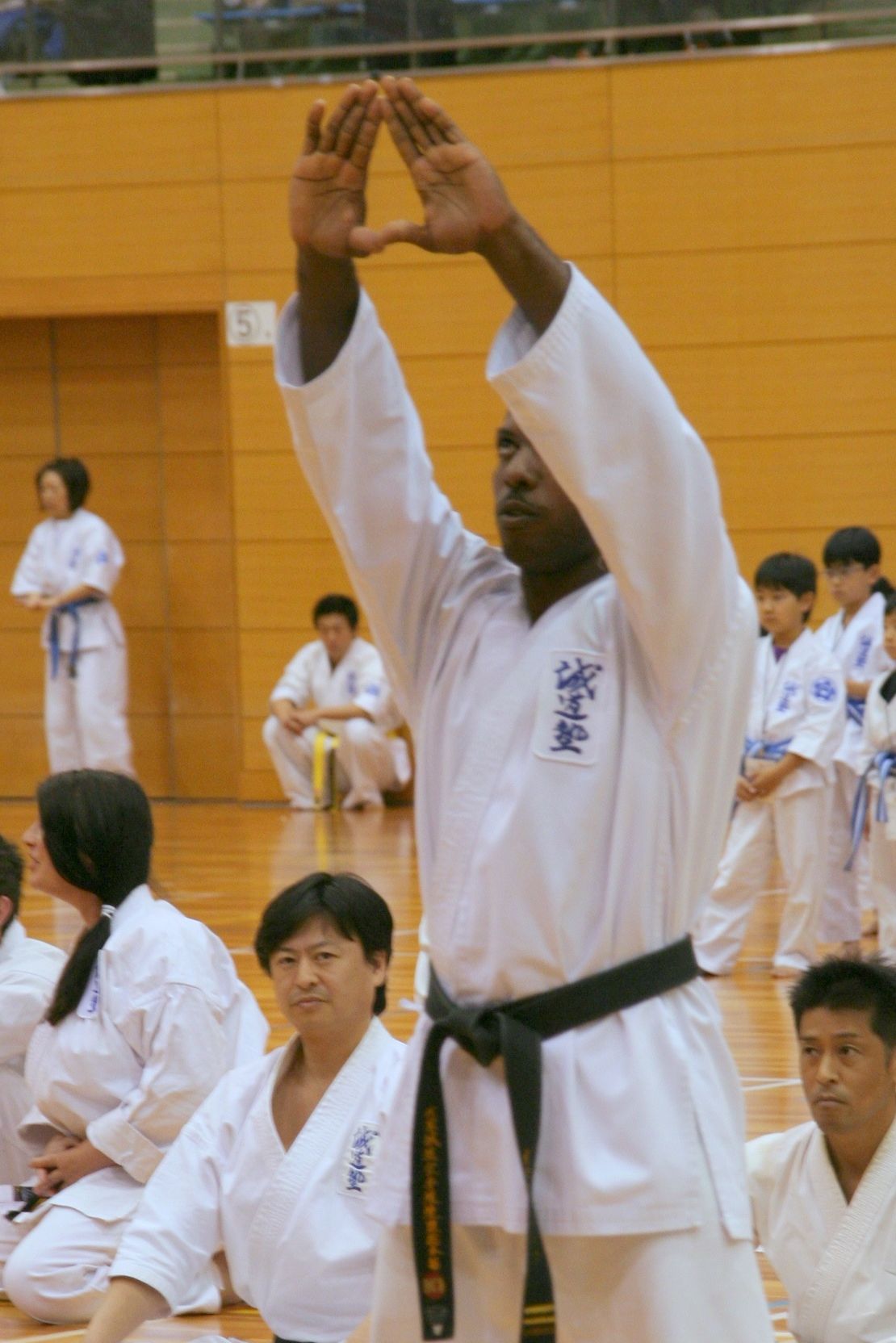
THE TRUE MEANING OF KATA

 By -- Conrad Miller


Mokuso!


<pause>


Sanchin Kata!


Yoi…


It is inevitable. Every karate practitioner, whether at the very beginning, as a white belt or even one day whilst casually rehearsing a kata, will eventually wonder… What really is kata? What is its importance/meaning? On my quest to improve as a student of Seido karate, I have researched this matter, in the hope that I may refresh those who already know, and also that those who wish to know may find an answer in short order.


The Japanese word, kata, can be roughly translated as a form, a kind of shadow boxing which applies karate techniques in a series of memorized patterns. Most sites/books described them as "a pre-arranged set of defensive moves and attacks against an imaginary single or multiple opponents". They contain plenty of very important elements which one needs to practice according to his/her personal level of training. When performing the karate practitioner must live and feel each single technique. In some, the speed varies from move to move while others are done at one speed and at one tempo but… is that all there is to it? From an early stage it became apparent to me, that our seniors seemed to know that there was much more to it than that.


Kata have been passed down to us from earlier masters. They are our heritage, reflecting the traditions from which our modern karate springs. Masters developed them as a way to catalog their techniques and strategies, and as a way to pass them on to others.


Katas were originally developed for several reasons. By developing them, the martial arts masters could help their students learn to apply fighting techniques with full force, because their opponents were imaginary. Also, the students could simulate fighting multiple opponents in dangerous situations, without fear of being injured. Observations of the animals themselves were also very important, as the masters watched how the animals moved and fought, and then found ways of including characteristics of those movements within them. Within each style there are also groupings of related ones that share a similar structure and focus on a specific set of skills. Within these groupings, and within the style as a whole, there is usually a well- defined progression from one kata or group to the next. Students are taught in an order that helps them build upon and enhance their basic skill. As students rise through their school ranks, they can become more elaborate to meet the growing need to challenge the students to improve their skills.

At black belt level, of course, the utmost knowledge is required. The principals apply an ever-widening variety of techniques in increasingly intricate sets, combinations, and speeds. Practicing in the mind is also a method which is, in its own right, a very important and effective way of training.

The ongoing challenge of this training is to strive to achieve perfection. Of course, no person ever truly attains this perfection. Because each person’s body is different, individual students will often find that some are easier and others more difficult for them to perform. Because the real meaning of the kata is camouflaged then, it is impossible to discover it without long serious and hard training. From simple body movements to deadly self-defense techniques; they still remain the focus of many traditional karate practitioners all over the world.


But…if, then, katas have such meaning and importance…how does one practice it in a way to attain maximum benefit? Well firstly, while doing a form, a student’s mind must be calm and clear. This is a very important point which will help the karate practitioner to truly understand the meaning of the said form. Studying on a regular basis will teach the student to combine defensive techniques and attacks with proper breathing. The essence of it is not in how beautiful the movements are, but how effective they are.

When performing in front of other people the practitioner should be able to make the audience feel the spirit and the strength of the techniques. So the question now was-How should a kata be done? Though there are many different spins on techniques, styles and applications of them, there are certain elements I found to be common:


BALANCE AND FLOW

The importance of balance, both physical and mental, cannot be stressed enough. One of the first lessons taught in karate is how to stand properly. Bending the knees in order to lower the center of gravity, the student advances, executing various techniques while maintaining balance and control over the body. Only after many hours of practice, combining upper and lower body techniques, does a sense of balance begin to develop. Because each kata teaches a new approach to balance, one should never be discouraged when balance is lost. Only through patience and hard work will the technique and balance improve. With just as much speed and power as the previous technique, it helps to develop and maintain balance while cultivating flow. Practicing continuous flow therefore helps the student to move smoothly from one technique to another. Only after learning to maintain balance and flow, can grace be obtained.

peeweekata1.jpg

CONTACT AND FOCUS

Remember that kata is performed by fighting imaginary opponents. Eye contact should always be made with the opponents, real or imaginary, so there should be no looking down unless it is called for.


SPEED, POWER, AND STRENGTH

Before trying to develop this aspect, the student must make sure that the technique is being properly executed. But, one must relax, if the body is too tense, the reflexes will become slower.


BREATHING


This component, I found, was an entire course by itself. Often taken for granted, breathing is a necessary function that our body performs day in and day out without conscious thought. However, when done correctly and controlled, breath can have not only great health benefits but also increase our strength when we need it most. An essential part of breath control is the use of the kiai (spirit joining) when executing atemi waza (destructive technique) and also when performing the ibuki.


As with anything else, there are stages of learning. At each level of study a student is introduced to new kata. Beginning sets teach movement, multiple techniques and pattern. Initially the student will be concerned with performing each technique correctly and which technique comes next. The mind is full of what you should be doing. This is the physical stage.

Eventually, practice becomes more automatic, attention falling more on the details of execution, rhythm and the spirit of the action. At this stage you begin to generate real power in your techniques and also begin to learn their application (called bunkai).


sheree.jpg

That stage is completed when it becomes a pure form- automatic, smooth, technically correct, powerful, and performed without conscious thought. This is the beginning of mental stage of kata - a form of mediation.

Beginning katas teach essentials, thus serving as prototypes for higher forms. Simple combinations and patterns are expanded in other forms at higher levels. In this way, the (beginning) Taikyokyu are expanded in Pinan, and later find full expression in Kanku and other forms. Groups of kata thus become circular; one leading to the next, a higher one in turn expands the knowledge of the lower ones. Each one is unique in that it has its own character. The names tend to tell a little of what that one is all about…hints to its meaning. For example:

Sanchin – In Chinese language “san’ means three. The second kanji is “chin” which today means "battle". The three battles, then, sanchin - are of the mind, the body and the spirit. The Sanchin of course, employs the “three” point stance. Combined in sanchin kata, we find peace of mind, body and spirit only if worked properly and under proper instruction.

Taikyoku means keeping an “open mind”, not restricting our focus, not clinging to a narrow view of any situation, be open to all possibilities.

 The Pinan kata are empty hand forms taught in many karate styles. The Chinese translation of Pinan is "safe from harm".


It is said that within kata, one can find all the basics and techniques used in kumite and self-defense. As we become older, our bodies in some ways become weaker. However, as we practice kata remember to seek what Seido describes as “the pursuit of true strength”, understanding that each of us practice from a different starting line and are pursuing it at a different speed. Let us continue to value the significance of kata and endeavor to practice it more earnestly. Naore. Osu!


References:


Shotokan Karate: A Precise History: Cook, Harry. 2001


My Empty Hand: Richardson Karate Kobudo Dojo


Karate Kyohon : Kaicho Tadashi Nakamura


scan0007.jpg


Introspection


It is always of great importance for all of us to continue to strive for that ever elusive perfection. 

You’ve been doing that mawashi geri the same way for years and it has ‘worked’ for you. This doesn’t necessarily mean that it IS perfect, or especially good.  We all know someone with that questionable technique that is a good fighter. It may very well be that very same unorthodox technique that continually surprises their opponent.

We need to know the orthodox, traditional, “right” way of doing things. The way one teaches new students with their blank slates has to be as near as possible to perfection; the established way of doing things. If it works in your kumite don’t abandon it, but strive to put other items in your arsenal. Thereby becoming an even more rounded individual.

Constant introspection is what all should have and cultivate, so we can all better ourselves. We should not feel threatened or offended if our peers point out a perceived fault. Before you dismiss it as having no value, check it out for yourself. Sometimes there is a need for a gentle reminder, especially when you have reached the dan grades. Don’t assume that the person is too self-important to be suggested to, and don’t be that person who is unwilling to receive objective criticism.


Osu!


the edge of experience

link to article by Sei Shihan Chris Caile

Maureen in Mandeville 1990 part 1
maureen.jpg

sca123n.jpg
Maureen and Ronald

Maureen in Mandeville 1990 part 2
maureen2.jpg

So much Space - Its all how you look at it. part 1
space.jpg

so much space part 2
new.jpg

Reprints of past Seido Mandeville articles.

1990 news letter pt.1
seidofam1.jpg

1990 newsletter pt. 2
seidofam2.jpg

PRACTICE WHAT YOU PREACH
practice.jpg

SPIRIT AND EFFORT


It's very easy for one to complain about someone's swimming when his feet are always dry. It's easy to say a place is dirty if your hands are always clean. The same is true of training and the martial arts. Some will criticize when that student has honestly put forth 100 percent, while they sit back in comfort, no sweat, no pain, and no risk of failure.


It takes a truly weak individual to belittle someone for an earnest effort. It's great when you see someone overcome adversity to achieve what he or she is seeking. They may not be champions, they may not even look the best in the dojo, but they show the spirit and conviction, which we treasure in Seido karate. They have cultivated a character, which is an asset to the class and to themselves,and yes they did get their feet wet.


Senpai Ronald Lyn (1991)

senpaiburt1.jpg
senpai Burt

"Sincere Way"